Rubber vulcanisation: process and benefits
Rubber Vulcanization: Process, Systems and Control in Technical Parts
Rubber vulcanization is the chemical process that transforms a mouldable compound into an elastic and stable network through the formation of bonds between its polymer chains. The result is vulcanized rubber capable of maintaining its shape, recovering more effectively after deformation and achieving the mechanical, thermal and durability performance expected from its formulation.
There is no single cycle that is valid for all rubbers. The curing system, temperature, time, pressure, geometry and thickness of the part must be defined together. In this article, we explain what the rubber vulcanization process involves, which systems are used and why controlling it is critical when manufacturing technical components.
What Is Rubber Vulcanization?
Vulcanization is a crosslinking reaction. Certain points along the elastomer chains become connected through chemical bonds, forming a three-dimensional network. This structure prevents the chains from sliding freely over one another when the part is subjected to a load.
Before curing, the compound must retain sufficient plasticity and flow to be mixed, preformed and fill the mould. After curing, it no longer behaves like a mouldable mass and becomes a stable elastomeric material. In the rubber industry, the terms curing and vulcanization are often used interchangeably.
What Changes in the Material Structure
The amount and type of bonds formed determine the crosslink density. A network that is not sufficiently developed can leave the material soft, sticky or with insufficient properties. Excessive crosslinking can reduce elongation and make the response too stiff or brittle for the application. The objective is not to “vulcanize as much as possible”, but to reach the curing state defined for the compound and the part.
What Is the Rubber Vulcanization Process by Moulding?
The process begins long before the mould is closed. The formulation and thermal history of the compound affect processing safety, reaction rate and final properties.
From Compound to Finished Product
Before obtaining a vulcanized part, the compound must go through a series of stages that determine its properties and behaviour in service.
- Formulation and mixing. The base elastomer, fillers, plasticizers, protective agents and vulcanization system are selected according to the required performance.
- Compound preparation. The material is conditioned and prepared in the appropriate quantity and form for the moulding system, avoiding premature heating that could initiate curing too early.
- Filling and forming. Through compression, transfer or injection, the compound enters the tooling and fills the cavity while the required pressure is applied.
- Application of the thermal cycle. Heat activates the curing system and the reaction progresses over a defined period. The most critical section of the part must reach a sufficient degree of vulcanization.
- Demoulding and subsequent operations. The part is removed once it has sufficient stability to do so. Depending on the elastomer and specification, trimming, washing, stabilization or post-curing may be required.
- Product control. The agreed characteristics are checked, such as dimensions, hardness, appearance and, where applicable, mechanical properties or functional performance.
At What Temperature Is Rubber Vulcanized?
There is no single rubber vulcanization temperature that is valid for all materials. In many hot moulding processes, an approximate range of 140 to 200 °C is used as a general reference, with cycles frequently around 150 to 185 °C. However, these values should not be treated as a recipe: the actual range depends on the elastomer, formulation, curing system, moulding method, part size and performance requirements.
The mould temperature does not necessarily correspond to the temperature immediately reached inside the component. Thick parts, geometries with changes in section and inserts can create differences in heating. For this reason, time and temperature must be analysed together.
Vulcanization Time, Thickness and Heat Transfer
Increasing the temperature generally accelerates the reaction, but it also reduces the safety margin before curing begins and can promote degradation, reversion or defects if the system does not allow for it. Conversely, a cycle that is too short can leave internal areas under-cured. Injection and curing times must take into account the kinetics of the compound and the time required for heat to reach the critical section of the part.
How the Degree of Cure Is Determined and Controlled
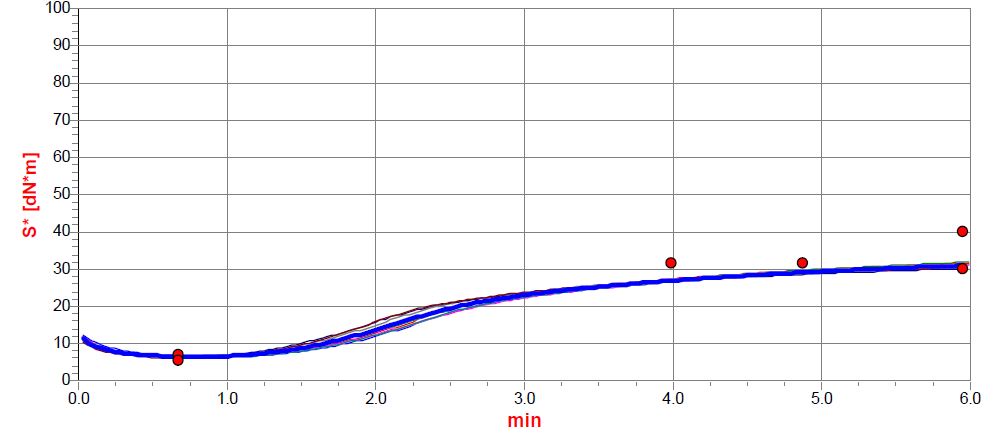
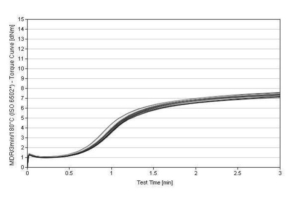
Cure rheometry makes it possible to study how the compound evolves at a given temperature. The resulting curve provides information about the safety margin against premature vulcanization, reaction rate, time required to reach a defined degree of cure and torque development, which is related to the development of the elastomeric network. These data help establish an initial process window, but they do not replace validation on the actual part. The thermal behaviour of the mould, material mass, geometry, inserts and filling method may require adjustments to the industrial cycle.
Properties of Vulcanized Rubber
When the formulation and process are appropriate, vulcanized rubber develops a combination of properties that the uncured compound cannot provide. The exact result depends on the polymer, fillers, additives, curing system and crosslink density.
How Vulcanization Affects Material Properties
Not all applications require the same balance between elasticity, hardness, dimensional stability and mechanical resistance. These are some of the properties that can be affected by the vulcanization process.
- Elastic recovery. The network limits permanent deformation and helps the part recover its geometry after the load is removed.
- Mechanical strength. The expected levels of tensile strength, elongation, tear resistance and resistance to repeated stresses can be developed.
- Hardness and modulus. Curing contributes to defining the compound’s resistance to penetration and stiffness, within the limits of the formulation.
- Dimensional stability. The material stops flowing like the raw compound and maintains its shape more effectively during use.
- Compression behaviour. The formulation and curing system influence permanent deformation, an essential aspect of seals and supports.
- Heat and ageing resistance. This can improve compared with the uncured material, although the achievable level depends on the elastomer family and type of bond.
Vulcanization Does Not Correct an Incorrect Material Selection
Correct vulcanization does not make every rubber suitable for every environment. Resistance to oils, fuels, steam, ozone, weathering or extreme temperatures depends primarily on the elastomer family and its formulation. The process allows the intended properties to be developed, but it does not eliminate the material’s inherent chemical limitations.
Differences Between Vulcanization Systems
Rubber can be vulcanized using different systems. The choice determines the nature of the bonds, process kinetics and part of the balance between elasticity, fatigue, compression set, thermal resistance and ageing.
| Most common systems | Advantages and considerations |
|---|---|
| Sulphur | High versatility and good dynamic performance. The sulphur/accelerator ratio makes it possible to formulate conventional, semi-efficient or efficient systems with different balances between fatigue, heat and compression set. |
| Peroxides | Mainly form carbon-carbon bonds. They can favour thermal stability and low compression set, but require control of by-products, oxygen, additive compatibility and process conditions. |
Vulcanized Natural Rubber
Vulcanized natural rubber stands out for its elasticity, fatigue resistance and good dynamic performance. It is usually cured using sulphur-based systems. However, it still has inherent limitations against ozone, weathering, certain oils and elevated temperatures; therefore, it should only be selected when the service environment is compatible.
What Happens When Curing Is Not Appropriate
The same compound can behave differently when curing conditions are not as expected. Some of the most common consequences are as follows.
| Condition | Possible consequences |
|---|---|
| Insufficient curing | Low hardness or modulus, sticky surface, insufficient mechanical properties, high deformation and variability. |
| Excessive curing or overcuring | Loss of elongation, degradation, changes in hardness, embrittlement or reversion in certain systems. |
| Premature vulcanization or scorch | Loss of flow before filling the mould, cold joints, incomplete filling and internal stresses. |
| Non-uniform temperature | Differences in properties between areas, an under-cured core or a surface exposed to excessive thermal history. |
Uses of Vulcanized Rubber in Technical Parts
Vulcanized rubber is used in components that must seal, isolate, absorb vibration, transmit movement or protect other elements. The same product designation can hide very different requirements, so each application needs a specific combination of elastomer, hardness, geometry and curing system.
| Part or application | Main performance characteristic to be controlled |
|---|---|
| Seals, oil seals and sealing profiles | Contact pressure, compression set, chemical compatibility, temperature and tolerances. |
| Membranes, diaphragms and bellows | Flexibility, fatigue, uniform thickness, sealing and response to repeated cycles. |
| Stops, supports and anti-vibration components | Stiffness, damping, load, frequency, ageing and dimensional stability. |
| Rollers and wheels | Abrasion, heat generation, adhesion, tear resistance and uniformity. |
| Grommets, caps and protective components | Assembly, insulation, environmental resistance, geometry and hardness. |
| Rubber-to-metal parts | Adhesion to the insert, surface preparation, shrinkage, stresses and thermal cycle. |
Vulcanization Control in MOELSI Manufacturing
In the manufacture of a technical part, material, tooling and production parameters form a single system. MOELSI processes compounds designed to achieve specific properties and performs vulcanization in the tooling of injection moulding machines, under appropriate pressure and temperature conditions.
During development, service requirements must be related to the elastomer family, formulation, geometry and moulding process. In production, control of the compound, mould temperature, cycle time, pressure and demoulding conditions helps reduce variations and maintain repeatability between batches.
From Geometric Data to the Actual Part
The curing curve provides a fundamental reference, but validation must be completed in the mould and with the actual part. A thick geometry, a complex cavity or a metal insert can modify heat transfer and filling. Therefore, defining the process requires combining material data, moulding experience and controls on the finished product.
Frequently Asked Questions About Rubber Vulcanization
What is vulcanized rubber?
It is a rubber compound whose polymer chains have been crosslinked using a curing system. The resulting network provides stability, useful elasticity and the properties defined by the formulation.
At what temperature is rubber vulcanized?
It depends on the elastomer, formulation, curing system and geometry. In hot moulding, approximate temperatures between 140 and 200 °C are common as a general reference, but the cycle must be validated for each compound and part.
Is vulcanization always carried out using sulphur?
No. Sulphur is very common in natural rubber and other unsaturated elastomers, but peroxide systems, metal oxides, resins and other specific chemistries are also used.
Does a longer vulcanization time mean better properties?
No. An insufficient time can leave the part under-cured, while excessive curing can cause overcuring, degradation or reversion depending on the material. The target degree of cure must be achieved.
Can vulcanized rubber be melted again?
In general, it does not behave like a thermoplastic. The chemical network does not simply break down when heated, and excessive temperature can degrade the material. Grinding, recovery and devulcanization processes exist, but they are not equivalent to conventional melting.
Proper Vulcanization Starts with Selecting the Right Material
At MOELSI, we manufacture custom rubber and silicone parts, relating formulation, geometry and process parameters to the actual service conditions. Explore the elastomer families and the criteria involved in material selection for technical parts.

