Rubber and silicone seals: types, applications and bespoke manufacturing
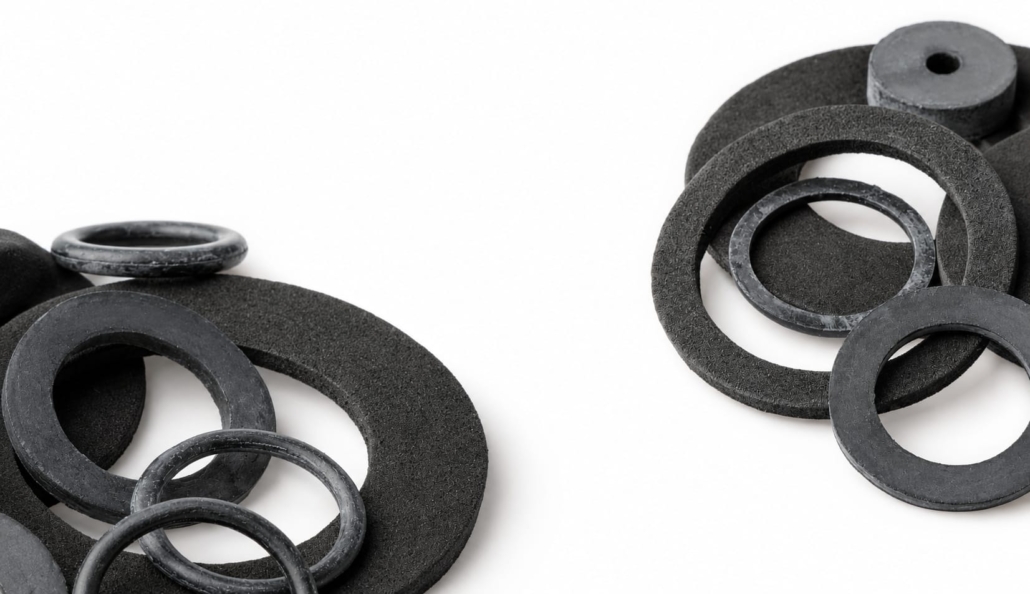
A gasket can determine the sealing performance and reliability of an industrial assembly. For this reason, its design and manufacturing must meet the actual operating conditions, housing geometry, and specific requirements of each application.
Although standard gaskets are available for certain requirements, many industrial applications require the development of a custom rubber or silicone gasket, manufactured according to drawings, technical specifications, or specific functional requirements.
In these cases, elastomer selection, geometry, tolerances, and manufacturing process are all part of the same solution.
Types of Industrial Gaskets and Their Applications
Industrial gaskets can have different geometries depending on the surface they need to seal, the assembly system, and the operating conditions.
O-Ring Gaskets
O-rings have a circular cross-section and create a tight seal between two surfaces. They are commonly used in static applications and can also be used in certain systems involving movement.
To ensure proper performance, factors such as gasket cross-section, housing dimensions, pressure, and material selection must be taken into account.
Flat Gaskets
Flat gaskets are positioned between two surfaces to prevent the passage of fluids, gases, or particles. They are commonly used in covers, flanges, housings, and other industrial assemblies.
Their geometry, thickness, and material can be adapted to the specific characteristics of the assembly in which they are integrated.
Custom Rubber Profiles and Gaskets
Profiles can be used to provide sealing along longitudinal paths, while custom gaskets make it possible to develop components adapted to geometries, housings, and requirements that cannot be properly addressed with a standard reference.
In these cases, the design starts from the project specifications and may require the assessment of dimensions, tolerances, material, assembly system, and operating conditions.
Rubber Gaskets and Silicone Gaskets: Differences and Applications
The choice between rubber and silicone depends on the conditions to which the component will be exposed. There is no single material that is universally suitable for every application.
When developing a custom gasket, the material should be selected based on factors such as temperature, chemical exposure, required elasticity, wear, and environmental conditions.
Rubber Characteristics
Rubber encompasses different elastomer families, each offering specific properties in terms of temperature resistance, resistance to oils, fuels and chemicals, wear, and environmental conditions.
Therefore, when developing rubber gaskets, it is necessary to select the elastomer that best meets the component’s operating conditions.
Silicone Characteristics
Silicone can be used in applications requiring specific temperature performance, as well as particular elasticity and material behaviour.
The choice between silicone and other rubber families should be based on the specific requirements of the application rather than solely on the geometry of the gasket.
Factors Affecting Gasket Design and Manufacturing
The development of an industrial gasket must take into account all the conditions to which it will be exposed during operation.
Operating Temperature and Pressure
Temperature can affect the properties of an elastomer and its ability to maintain an effective seal. It is therefore important to consider both the normal operating temperature and any potential variations or temperature peaks.
Pressure also influences gasket performance and must be compatible with its geometry, material, and sealing system.
Contact with Chemicals
Oils, fuels, detergents, solvents, and other substances can affect different types of elastomers in different ways.
When contact with these substances is expected, material chemical compatibility should be considered as part of the component development process.
Wear and Environmental Conditions
Movement, friction, and the number of operating cycles can affect gasket service life. Other factors such as humidity, radiation, dust, or outdoor exposure should also be considered.
In demanding industrial applications, analysing all these conditions together helps define an appropriate sealing solution from the design stage.
When Is a Custom Gasket Required?
A standard gasket can meet certain requirements, but there is not always an off-the-shelf reference that fits an industrial assembly correctly.
When an application involves specific geometry, defined tolerances, or particular operating conditions, custom gasket manufacturing makes it possible to develop a component according to the actual requirements of the project.
When the Part Requires a Specific Geometry
A custom gasket may be required when the housing has specific dimensions, complex shapes, or particular tolerances.
In these cases, development starts from the part drawing, technical specifications, or assembly characteristics, defining a geometry that is compatible with the assembly system.
When a Specific Material Is Required
Operating conditions may require a particular type of elastomer depending on temperature, chemical resistance, wear, elasticity, or other requirements.
Custom manufacturing makes it possible to combine the part geometry with the material best suited to the application.
When a Part Is Required for Series Production
In industrial projects, obtaining an initial part that meets dimensional requirements is not enough. The manufacturing process must also allow stable and repeatable characteristics to be maintained throughout production.
For this reason, developing a custom gasket also involves assessing the manufacturing process, tolerances, and quality requirements needed to achieve consistent production.
From Drawing to Rubber and Silicone Gasket Manufacturing
The manufacturing of a custom gasket begins with understanding the requirements of the project.
Based on the drawing, technical specifications, or functional requirements, aspects such as the following can be assessed:
- Part geometry and dimensions.
- Required tolerances.
- Elastomer material and hardness.
- Operating temperature and pressure.
- Compatibility with fluids or chemicals.
- Assembly system and operating conditions.
- Production and repeatability requirements.
This information makes it possible to define the appropriate technical solution and manufacturing process to obtain a component that meets the requirements of the assembly.
At Moelsi, we develop and manufacture custom rubber and silicone gaskets for industrial applications, working from the project drawing or specifications. We analyse the geometry, material, and manufacturing process to develop a solution focused on quality, repeatability, and series production.
Do you need to manufacture a custom gasket?
Send us your drawing or specifications, and we will assess your project to determine the most suitable solution.

