Shore hardness in rubber and silicone: a practical guide
Una part can be manufactured using the right elastomer family and still fail to perform correctly if it is too soft or too hard. Shore hardness in rubber and silicone makes it possible to define and control resistance to indentation, but the number is only meaningful when considered together with the scale, the geometry of the part and its actual service conditions.
In this guide, we explain what Shore hardness means in rubber and silicone, when Shore A and Shore D scales are used, how hardness is measured and which ranges are commonly used for seals, membranes, stops, supports and other technical parts.
What Does Shore Hardness Mean in Rubber and Silicone?
Shore hardness expresses the resistance a material offers to the penetration of an indenter under defined test conditions. The durometer applies a specific geometry and force and provides a result between 0 and 100 within the selected scale.
A low value corresponds to a material that allows greater penetration and is generally perceived as softer. A high value indicates greater resistance to penetration.
The result is not a percentage or a conventional unit of measurement: it must always be stated together with the scale, for example, 60 Shore A.
Hardness Does Not Describe the Material’s Entire Behaviour
Rubber hardness is an important property, but it does not replace other functional characteristics.
Two compounds with the same Shore value may offer different elasticity, elongation, tear resistance, abrasion resistance, rebound, compression set or behaviour when exposed to temperature, oils, chemicals and ageing.
It is also important to distinguish material hardness from part flexibility. A thin membrane and a solid block manufactured from the same compound may have the same Shore hardness but behave very differently due to their thickness, shape and load-bearing cross-section.
Differences Between Shore A and Shore D
The scale is selected according to the material’s hardness range. Most vulcanised rubbers and moulded silicones are measured using Shore A. Shore D is used when the material is too hard to obtain a suitable reading on the Shore A scale, as is the case with some high-hardness elastomers and engineering polymers.
Shore A: The Standard Scale for Rubber and Silicone
The Shore A scale covers a large proportion of flexible elastomeric parts. A 30 Shore A silicone deforms more easily than a 70 Shore A silicone.
In rubber, moving from a soft compound to a harder one can affect sealing, assembly force, stability under load, damping and the ability to adapt to surfaces with tolerances.
Shore D: For Higher-Hardness Materials
Shore D uses a different indenter and force and is intended for a range of harder materials. It should not be selected simply because a “high number” is required; it should be used when the nature and hardness of the material make this scale appropriate.
70 Shore A and 70 Shore D do not represent the same hardness. There is no universal exact conversion between the two scales, so a specification should always indicate both the value and the scale.
How Is Rubber and Silicone Hardness Measured?

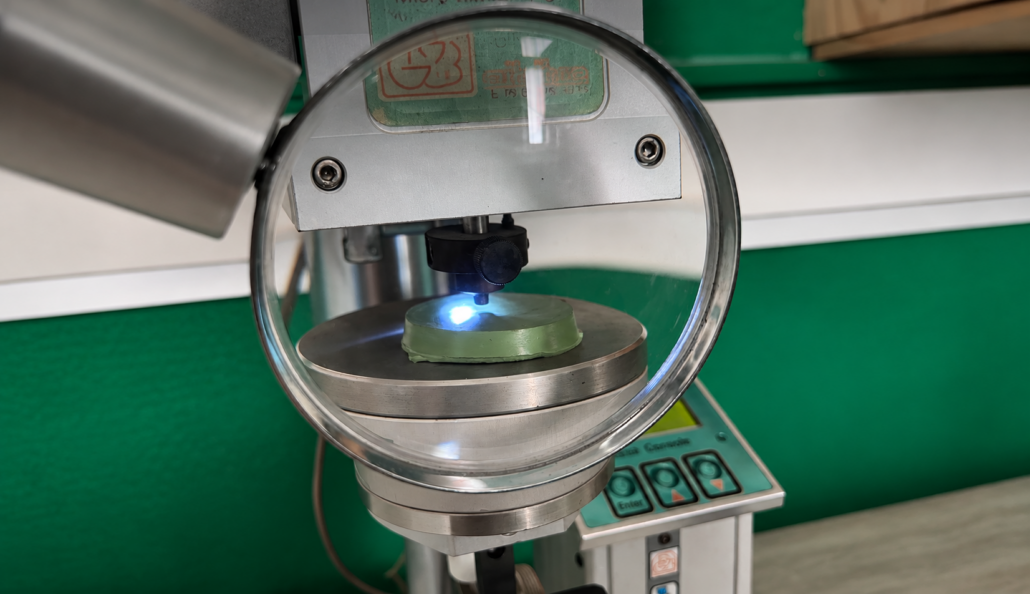
Hardness is measured using a durometer appropriate to the selected scale. The instrument is positioned perpendicular to a stable surface and the indenter presses into the material. To ensure repeatable results, the test method must define the testing conditions and remain consistent between samples, batches and suppliers.
Factors That Can Affect the Reading
- Sample thickness and the possibility of the underlying support influencing penetration.
- Distance from edges, holes, ribs or sudden changes in cross-section.
- Curvature, surface roughness or lack of flatness in the measurement area.
- Temperature and prior conditioning of the material.
- Perpendicularity and the speed at which the durometer is applied.
- Time elapsed between contact and the reading.
- Equipment calibration and repeatability between operators.
For small, curved or thin parts, measuring directly on any point of the component may not provide a reliable result. In these cases, control can be carried out on a test specimen or plate manufactured using the same compound and under equivalent curing conditions, or through a specific method agreed with the customer.
To avoid discrepancies, a technical specification should indicate the applicable standard or procedure — for example, ISO 48-4 or ASTM D2240 — the scale, the tolerance and, when necessary, the measurement conditions.
What Shore Hardness Is Suitable for Each Application?
There is no universal hardness for a seal, stop or membrane. The choice depends on the material, load, compression percentage, contact pressure, geometry, assembly, temperature, chemical environment and expected service life.
Indicative Hardness Ranges by Product Type
The following ranges are indicative. They may vary depending on the formulation, part design, tolerances and service conditions.
| Product or application | Indicative range | What it generally favours |
|---|---|---|
| Membranes, bellows and highly flexible silicone parts | 20-40 Shore A | Deformation with low force and adaptation to movement. |
| Soft seals, caps and conformable sealing elements | 30-50 Shore A | Adaptation to surfaces and sealing with moderate loads. |
| Anti-vibration supports, dampers and flexible stops | 40-60 Shore A | Balance between deformation, absorption and stability. |
| Technical seals, profiles and general-purpose parts | 50-70 Shore A | Balance between sealing, resistance and ease of assembly. |
| O-rings and sealing elements subjected to higher loads | 60-80 Shore A | Greater dimensional stability and resistance to extrusion, depending on the design. |
| Stops, rollers, scrapers and higher-rigidity supports | 70-90 Shore A | Less deformation under load and greater support. |
| Very hard elastomers and certain engineering polymers | 40-70 Shore D | Semi-rigid behaviour; must be validated for each material. |
How Excessively Low or High Hardness Can Affect a Part
Low hardness may be necessary for a seal to conform to irregularities or for a membrane to operate with little force. However, if the compound is too soft for the expected load, the part may deform excessively, lose stability, become pinched during assembly or fail to return to the expected position after pressure is applied.
High hardness can improve support and reduce deformation, but it can also increase assembly force or prevent the component from adapting to the contact surface. In sealing applications, an excessively hard part may require a higher compression load to generate the necessary contact pressure.
Factors That Determine Hardness in Rubber and Silicone
The hardness of rubber or silicone does not depend solely on the base polymer. It is also influenced by the compound formulation, the type and proportion of fillers and plasticisers, the vulcanisation or curing system, the crosslink density and the final degree of cure achieved.
During manufacturing, variables such as temperature, time and pressure must be controlled to obtain consistent hardness between parts and batches.
When the formulation and specification require it, particularly in certain peroxide-cured compounds, post-curing may also be applied. Post-curing can be used to remove volatile by-products, complete or stabilise the curing state and achieve the specified final properties. It is not an operation exclusive to silicones, as it may also be required for other elastomers and vulcanisation systems. We will dedicate another article to explaining the different curing systems and their influence on the final properties of parts in greater detail.
Higher Shore hardness does not automatically imply greater resistance to temperature, tearing, abrasion or compression set. These properties also depend on the formulation and crosslinking system, so they must be specified and verified separately.
How to Specify Shore Hardness on a Drawing
Simply stating “hardness 70” leaves the specification incomplete. To ensure that purchasing, engineering, quality and manufacturing teams work to the same criteria, it is advisable to include:
- Nominal value and tolerance: for example, 70 ± 5.
- Scale: Shore A or Shore D. Agreed test standard or procedure.
- Measurement area or type of test specimen when part geometry may influence the result.
- Special conditioning or reading conditions, if critical.
- Other required functional properties: compression set, tear resistance, tensile strength, elongation, abrasion resistance or chemical compatibility.
70 ± 5 Shore A, measured according to the agreed procedure on a control specimen manufactured using the same compound and under defined curing conditions. The final wording should be adapted to the applicable standard, design and project control plan.
Frequently Asked Questions About Shore Hardness
What Does 70 Shore A Mean?
It means that the material offers a resistance to indentation corresponding to 70 points on the Shore A scale. It is a common hardness for many seals and technical parts, but its suitability depends on the geometry and operating conditions.
Can Shore A and Shore D Be Converted?
Approximate comparison tables exist for some materials, but there is no universal exact conversion. For quality control, the specified scale should be used rather than replacing it with another scale through a generic equivalence.
Does Higher Hardness Mean Greater Wear Resistance?
Not necessarily. Abrasion depends on the formulation, elastomer type, fillers, surface finish, pressure, speed and environment. Hardness can have an influence, but it cannot by itself predict wear life.
Can Hardness Be Measured Directly on the Finished Part?
Yes, when the part has an area with sufficient thickness, flatness and dimensions for the selected method. If the geometry affects the reading, a control specimen or specific procedure should be agreed upon.
From Required Hardness to a Manufacturable Part
Choosing the right hardness requires combining compound behaviour with part design and the moulding process. At MOELSI, we analyse the part’s function, operating environment and production requirements to propose a consistent solution in rubber, silicone or liquid silicone.
During industrialisation, hardness is one of the variables that must be controlled to maintain process stability and consistency between batches. The objective is not to achieve an isolated number, but to manufacture a part that performs its function consistently and repeatedly.
Do you need to define or manufacture a part with a specific hardness? Trust your project to a technical partner with experience in elastomers. At MOELSI, we manufacture custom rubber and silicone parts and work to achieve the hardness and performance required by each application. Tell us about your project and share your part requirements with us.
Note: the table is indicative and does not replace technical validation of the material, geometry and service conditions.

